




Best Martial Arts for Children by Age: A Parent's Guide (5 to 13+)
One of the most common questions martial arts schools hear from parents is:
What is the best age for my child to start martial arts?
Search online and you will find martial arts classes advertised for children as young as three. You will also find Karate for four-year-olds, Taekwondo for preschool children, Brazilian Jiu-Jitsu for five-year-olds and numerous "Little Ninja" programmes aimed at very young children.
A five-year-old and a thirteen-year-old are at completely different stages physically, mentally and emotionally. What works brilliantly for one age group may be unsuitable for another.
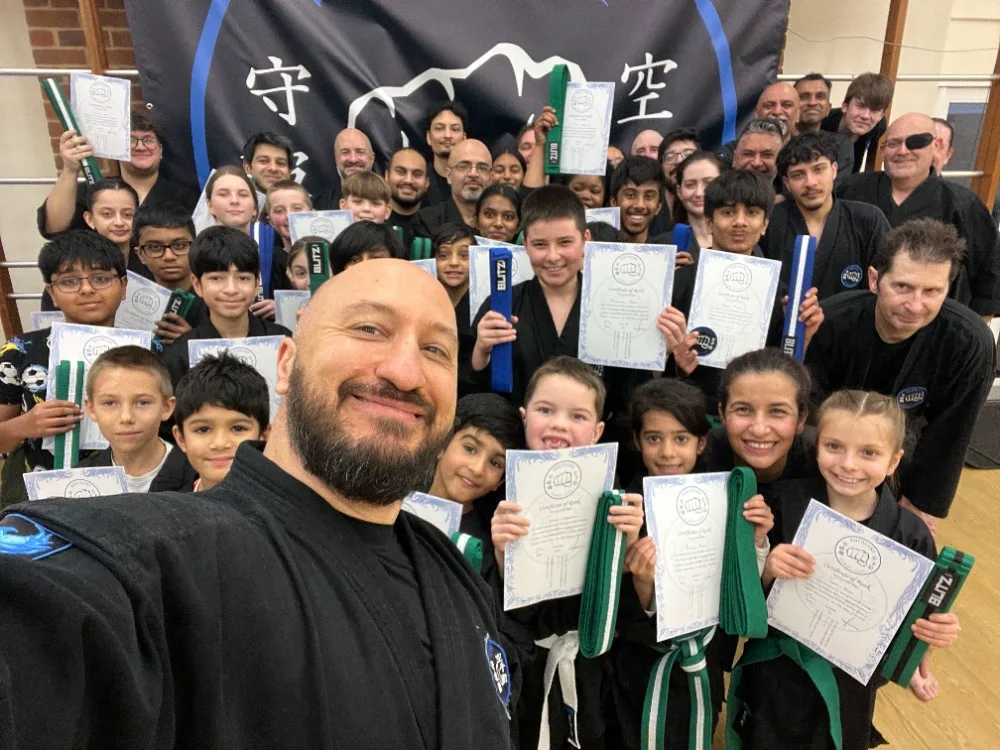
At Shuhari Self Defence, we have taught thousands of students since opening our first class in 2010, and our children's martial arts classes start from age seven.
That isn't because younger children cannot benefit from physical activity. They absolutely can.
It is because we believe there is an important difference between play based, martial arts-themed activity and genuine martial arts training.
This guide explains what children are generally capable of at different ages, which martial arts may suit them, when structured training becomes particularly valuable, and what parents should look for when choosing a club.
Martial Arts for Children by Age: Quick Guide
| Age | Developmental Focus | Suitable Training |
|---|---|---|
| 5-6 | Following instructions, body awareness, basic technique | Introductory Taekwondo, Kung Fu, Kickboxing, movement-based training |
| 7-9 | Technique, discipline, confidence, controlled partner work | Karate, Muay Thai |
| 10-12 | More complex technique, fitness, controlled sparring, self-defence | Judo, BJJ, Sambo, self-defence drills |
| 13+ | Advanced technique, physical conditioning, confidence, realistic application | MMA, Contact sparring, conditioning, multiple opponents & weapons training |
These are guidelines rather than rigid rules.
Children develop at different speeds. A mature six-year-old may concentrate better than some eight-year-olds, while another child may benefit from waiting slightly longer.
The quality and structure of the class also matter enormously.
Martial Arts for 3-Year-Olds and 4-Year-Olds
This age group is simply too young to receive proper martial arts tuition. Any class aimed at this age is simply a martial arts themed, games-based activity.
A three-year-old simply should not be taught: how to rear naked choke a person or how to elbow someone in the head. The maturity to know when not to use what they learn is simply not there yet.
At three or four, most children are still developing fundamental physical abilities such as balance, coordination and spatial awareness. Their ability to concentrate for extended periods is limited.
At this age, the real benefit is usually general physical and social development rather than learning practical martial arts.
Gymnastics would be a good alternative because it develops many of the physical foundations that later help martial arts: balance, flexibility, strength and body awareness.
Martial Arts for 5-Year-Olds and 6-Year-Olds
Between five and six, things begin to change.
Children generally become better at listening to instructions, copying movements and understanding simple rules.
This makes introductory martial arts training more realistic.
A good programme might begin introducing:
- Basic punches
- Basic kicks
- Stances
- Breakfalls
- Simple combinations
- Basic partner exercises
- Balance drills
- Discipline and etiquette
Taekwondo, Kung Fu and Kickboxing are common choices at this age because techniques can initially be practised individually.
Should a 5-Year-Old Do Martial Arts?
They certainly can, provided the programme is designed specifically for younger children.
However, parents should not expect a five-year-old to train in exactly the same way as an older child.
There is a significant difference between copying a punching combination on pads and understanding when, why and how that technique should actually be used.
At this age, martial arts would still contain a strong element of play and general physical development.
Why Shuhari Starts Children's Martial Arts at Age 7
At Shuhari Self Defence, our children's classes begin at seven years old.
This is deliberate.
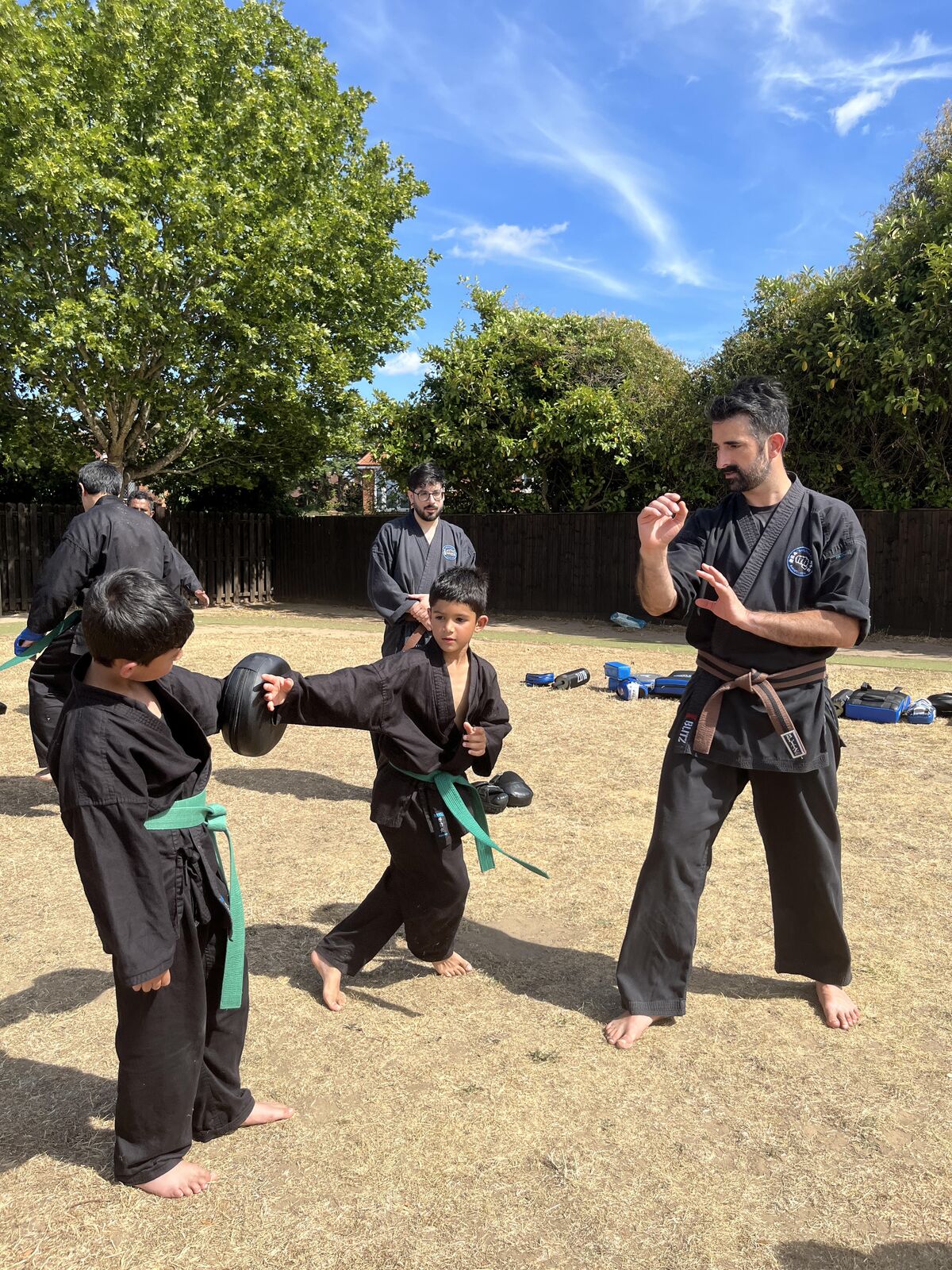
Our curriculum isn't simply martial arts-themed exercise. Students learn practical techniques from several martial arts and self-defence systems, work with partners and gradually experience controlled physical pressure.
To train effectively and safely, children need to be able to:
- Listen carefully to instructions
- Understand safety rules
- Control their strength
- Work responsibly with a partner
- Recognise when to stop
- Remember combinations
- Understand basic tactical concepts
- Cope with controlled physical contact
By around seven, most children are considerably better equipped to do these things.
Starting martial arts earlier isn't necessarily an advantage.
Martial arts is a long journey. A child who begins genuine structured training at seven has an enormous amount of time to develop.
What matters far more than starting as early as possible is starting when the child is ready and then training consistently.
Martial Arts for 7-Year-Olds to 9-Year-Olds
For many children, seven to nine is an excellent age to begin formal martial arts training.
Children in this age range are generally capable of understanding more detailed instructions while still being extremely receptive to learning new physical skills.
This is where martial arts can begin developing much more than coordination or balance.
Children can start learning:
Technique
Punches, kicks, blocks, throws, escapes and grappling movements can be taught with greater attention to correct mechanics.
Discipline
Students learn that improvement requires repetition. Sometimes you practise something because it needs improving, not simply because it is your favourite technique.
Partner skills
Children begin understanding distance, timing, resistance and resilience.
Self-control
Martial arts teaches children that physical ability comes with responsibility.
Which Martial Art Is Best for a 7-Year-Old?
There isn't one universally "best" martial art.
Different disciplines develop different abilities.
Karate develops striking technique, toughness, speed and distance management.
Judo develops balance, throwing, breakfalls and close-range grappling.
Brazilian Jiu-Jitsu (BJJ) develops positional control, problem-solving and ground grappling.
Boxing and Kickboxing develop striking, footwork, timing and fitness.
Each has advantages.
At Shuhari, we take a broader approach rather than limiting students to one discipline.
Our curriculum draws techniques and training methods from Karate, Boxing, Wrestling, Krav Maga, Kung Fu, Judo, Brazilian Jiu-Jitsu, Kickboxing and Muay Thai.
The objective is to develop a well-rounded martial artist rather than simply a specialist in one area.
Martial Arts for 10-Year-Olds to 12-Year-Olds
Between ten and twelve, children often make significant progress.
They are physically stronger, their coordination has improved and they can understand more complicated technical and tactical concepts.
This means training can become more demanding.
Students can begin working more seriously on:
- Punching and kicking combinations
- Defensive movement
- Takedowns
- Throws
- Grappling
- Escapes
- Pad work
- Fitness
- Controlled sparring
- Situational awareness
- Practical self-defence
This is also an important age psychologically.
Children are approaching secondary school, friendships become more complicated and social pressure increases.
Confidence becomes increasingly important.
Martial Arts and Bullying
Parents often enquire about martial arts because their child is being bullied or they are worried about what might happen when their child moves to secondary school.
Children need to understand awareness, confidence, verbal boundaries, de-escalation.
Physical techniques are there for situations where avoidance has failed.
Knowing that they have the ability to protect themselves can also change how children carry themselves.
The goal is a child who can remain calm because they know what to do.
Martial Arts for Teenagers: Age 13+
The teenage years bring another major change.
Teenagers are becoming physically larger and stronger, while simultaneously dealing with greater independence, academic pressure and more complex social situations.
Teenagers can develop:
- Advanced striking
- Grappling
- Throws and takedowns
- Combination work
- Contact sparring
- Strength and conditioning
- Tactical decision-making
- Practical self-defence
- De-escalation
- Confidence under pressure
- Weapon awareness
- Multiple opponents skills
At this stage, training can increasingly resemble adult martial arts while still being appropriately supervised.
Why Martial Arts Can Be Particularly Valuable for Teenagers
Teenagers often need something they can genuinely progress at.
Martial arts provide a clear pathway.
You arrive as a beginner. You learn. You struggle. You improve. You grade.
Eventually, the techniques that once felt awkward become natural.
That process teaches an important lesson:
Competence is earned through consistent effort.
That lesson extends far beyond martial arts.
A teenager who learns to remain composed while sparring, keeps training when a technique is difficult and eventually achieves something they previously couldn't do is developing resilience that can transfer into school, work and adult life.
Does the Martial Art Matter More Than the Instructor?
Usually, no.
Parents understandably spend a lot of time asking:
"Should my child do Karate or Taekwondo?"
"Is BJJ better than Judo?"
"Should they learn Kickboxing?"
These are reasonable questions.
But the quality of the club often matters more than the name above the door.
An excellent Judo instructor is likely to provide far more value than a bad Taekwondo instructor, and vice versa.
When choosing a martial arts club for your child, look beyond the style.
What Parents Should Look for in a Children's Martial Arts Club
1. Experienced Instructors
Ask who actually teaches the children's classes.
Experience matters, particularly when instructors are responsible for controlled contact between children.
2. A Structured Curriculum
Children should have a clear progression pathway.
There should be skills to learn, standards to meet and progressively more difficult challenges.
A belt system can be very useful when it reflects genuine development rather than simply attendance.
3. Appropriate Discipline
A martial arts class should be enjoyable, but it shouldn't be an hour of uncontrolled play.
Children should learn to listen, respect their training partners and respond to instruction.
4. Controlled Contact
The only proper way to learn martial arts is to experience resistance.
At the same time, children should not simply be thrown into hard sparring straight away.
Contact should be introduced gradually and responsibly according to experience and ability.
5. Practical Skills
Ask what students are actually learning.
Does the programme focus entirely on forms? Competition? Fitness? Self-defence?
There is no single correct answer, but parents should know what the club is designed to achieve.
6. A Safe Environment
Good instruction includes clear rules about control, appropriate supervision and respect between training partners.
7. A Club Your Child Actually Enjoys
This is easily overlooked.
The "perfect" martial art is useless if your child hates attending.
Consistency beats theoretical perfection.
If your child enjoys the environment, respects the instructors and looks forward to training, they are far more likely to stay long enough to receive the real benefits.
Is Karate Good for Children?
Yes.
Karate is an excellent martial art for children because it develops coordination, balance, striking technique, discipline and control.
It also provides a structured progression system that children can understand.
However, Karate schools vary considerably.
Some focus heavily on kata and traditional technique. Others include more sparring and practical application.
Parents should therefore evaluate the individual club rather than assuming every Karate school provides the same training.
Is Brazilian Jiu-Jitsu Good for Children?
BJJ can also be excellent for children.
Because Brazilian Jiu-Jitsu focuses heavily on grappling, students learn how to control another person, escape difficult positions and solve physical problems while under pressure.
It can be particularly useful for developing composure.
However, BJJ primarily focuses on ground fighting.
For broad self-defence, we believe children benefit from understanding striking first, then grappling.
Is Judo Good for Children?
Judo is an outstanding martial art.
Children learn balance, breakfalls, throws, pins and grappling while developing physical confidence.
Learning how to fall correctly is itself a useful lifelong skill.
Judo can also teach children how to remain calm while another person is physically challenging them.
Is Kickboxing Good for Children?
Kickboxing can be excellent for fitness, coordination, striking and confidence.
Pad work is engaging and provides immediate feedback, which many children enjoy.
As with any striking art, the important question is how sparring is introduced.
Children should learn control before intensity.
What Is the Best Martial Art for Children's Self-Defence?
If self-defence is the main goal, we don't believe there is one perfect martial art.
Real confrontations don't remain conveniently inside the rules of a particular sport.
Someone might grab you. They might punch. They might push. You might fall.
The situation could begin verbally before becoming physical.
That is why well-rounded self-defence training should expose students to different ranges and situations.
A child doesn't need to become an expert boxer, wrestler and Judoka simultaneously.
But understanding the fundamentals of striking, grappling, movement, awareness and de-escalation gives them a broader foundation.
How Often Should Children Train?
For beginners, even two classes per week provide value.
Consistency is the key.
Three sessions + per week allows skills to develop considerably faster.
What If My Child Is Shy?
Martial arts can be particularly beneficial for quieter children.
Progress is personal.
A child learns one technique. Then another.
They become comfortable with their instructor.
They find a training partner.
They achieve their first grade.
Confidence develops gradually through real achievement.
We regularly see children who barely speak during their first few classes eventually become confident senior students helping newer beginners.
What If My Child Isn't Athletic?
That's completely fine.
Your child doesn't need to be fit, flexible, strong or coordinated before starting martial arts.
Those are things training develops.
In fact, waiting until a child is "fit enough" to start defeats much of the purpose.
A good beginner programme meets students where they are and develops them progressively.
Children's Martial Arts at Shuhari Self Defence
Shuhari Self Defence has been teaching martial arts and practical self-defence since 2010.
Our children's classes are suitable from age seven upwards, with training available across our Berkshire locations.
Rather than teaching one martial art exclusively, our syllabus draws from:
- Karate
- Boxing
- Wrestling
- Krav Maga
- Kung Fu
- Judo
- Brazilian Jiu-Jitsu
- Kickboxing
- Muay Thai
Students develop striking, grappling, fitness, coordination, discipline, confidence and practical self-defence skills within a structured syllabus.
We also place considerable emphasis on the mental side of training.
Frequently Asked Questions
Can a 3-year-old do martial arts?
Not really. At that age, classes would be martial arts themed movement and games.
What is the best age to start martial arts?
We believe 7 is the best age to start.
What is the best martial art for a 5-year-old?
Karate, Taekwondo, Judo and introductory BJJ programmes can all work well, provided the class is specifically designed for young children. The instructor and teaching environment matter more than choosing the supposedly "best" style.
Which martial art is best for children: Karate, Judo or BJJ?
All three can be excellent. Karate primarily develops striking and movement, Judo focuses on throws and grappling, while BJJ specialises in ground fighting. For practical self-defence, exposure to both striking and grappling provides a particularly useful foundation.
Will martial arts make my child aggressive?
Good martial arts training should teach the opposite. Children learn control, discipline and responsibility alongside physical skills. Being capable of defending yourself doesn't mean looking for opportunities to do so.
How many times per week should a child train martial arts?
Two classes per week generally produces good technical development and familiarity. 3-4 days a week is better.
Ready to Try Martial Arts?
Shuhari Self Defence offers children's martial arts and self-defence classes from age seven, with classes suitable for complete beginners.
Your child doesn't need previous martial arts experience and doesn't need to be fit before starting.
They simply need to be ready to learn.
Enquire today about a free trial children's martial arts class and find your nearest Shuhari location.