





Which Martial Art Is Best for Self-Defence? A Brief Comparison
If you've ever typed "best martial art for self defence" into a search engine, you've probably encountered fierce debates, contradictory advice, and passionate advocates for every discipline imaginable. The truth? There's no single correct answer but there are wrong ways to approach the question entirely.
After sixteen years of teaching self-defence across Berkshire and training over 8,600 students, we've learned that real-world protection rarely matches what you see in competition rings or martial arts films. Street encounters are chaotic, unpredictable, and often over quickly. The martial art that serves you best depends entirely on understanding what "effective" actually means outside the dojo.
This guide cuts through the marketing hype to examine what genuinely works when your safety is on the line.
What Makes a Martial Art Effective for Self-Defence?
Before comparing specific disciplines, we need to establish criteria that matter in genuine threat situations not sport competitions or controlled sparring environments.
Simplicity under stress: When adrenaline floods your system, fine motor skills deteriorate rapidly. Techniques requiring precise movements or complex combinations often fail when you're genuinely frightened. The most effective martial arts teach gross motor movements that remain accessible even when your knees are shaking.
Speed of acquisition: How quickly can someone develop functional skills? A discipline requiring five years before you can adequately protect yourself serves a different purpose than one teaching practical responses within the first year.
Scenario coverage: Real threats don't follow rules. Does the art address standing confrontations, ground situations, multiple attackers, and weapon threats? Single-focus disciplines inevitably leave gaps.
Legal defensibility: Techniques must be proportionate to threats. Skills that cause excessive injury, even in genuine self-defence situations, can create serious legal consequences under UK law.
Awareness and prevention: The best self-defence happens before physical contact. Does the training develop situational awareness and de-escalation capabilities?
With these criteria established, let's examine the major disciplines.
Krav Maga: Purpose-Built for Street Defence
Krav Maga was designed with one objective: neutralise threats as quickly as possible using whatever means necessary.
Unlike traditional martial arts, Krav Maga has no sporting component. Every technique serves the singular purpose of ending dangerous situations rapidly. Training emphasises pre-emption, aggressive counterattacks targeting vulnerable areas like eyes, throat, groin, combined with practical defences against common street attacks, chokes, and weapon threats.
The philosophy prioritises survival over fairness. Students learn to use environmental objects, strike pre-emptively when danger is imminent, and continue attacking until they can safely escape.
Strengths: Rapid awareness development, addresses weapon threats comprehensively, teaches realistic scenario responses, develops aggressive mindset when needed.
Limitations: Quality varies dramatically between instructors, sometimes it lacks skilled full resistance sparring or grappling and stays as compliant partner drill oriented.
Best for: Adults seeking practical self-defence skills without interest in traditional martial arts culture or sporting competition.
Brazilian Jiu-Jitsu: Controlling Threats on the Ground
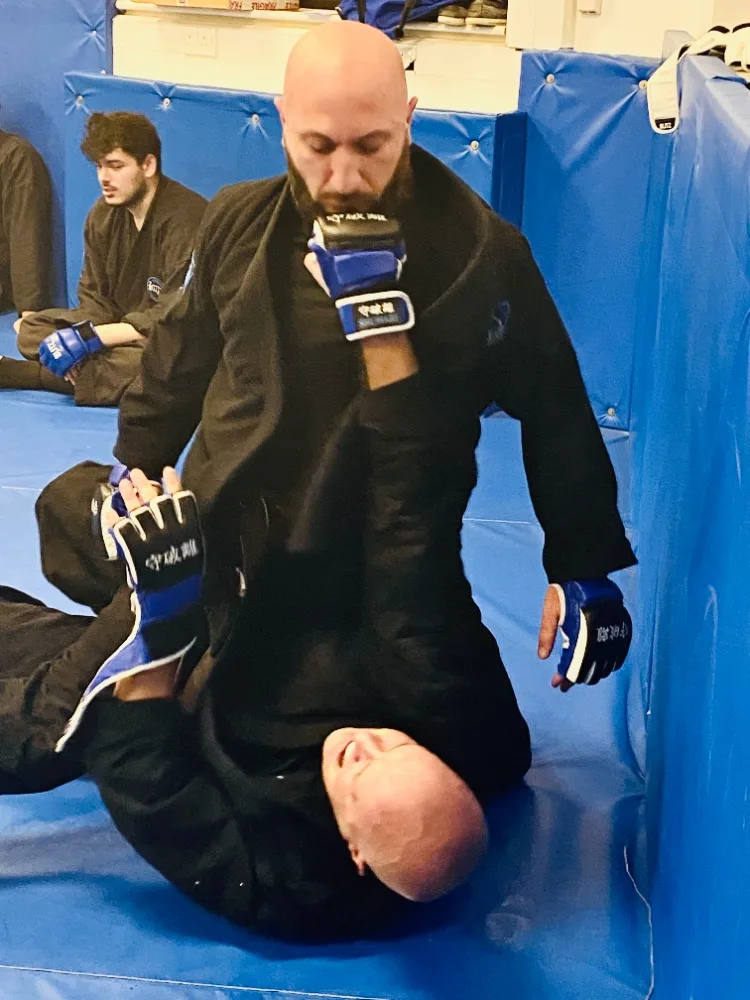
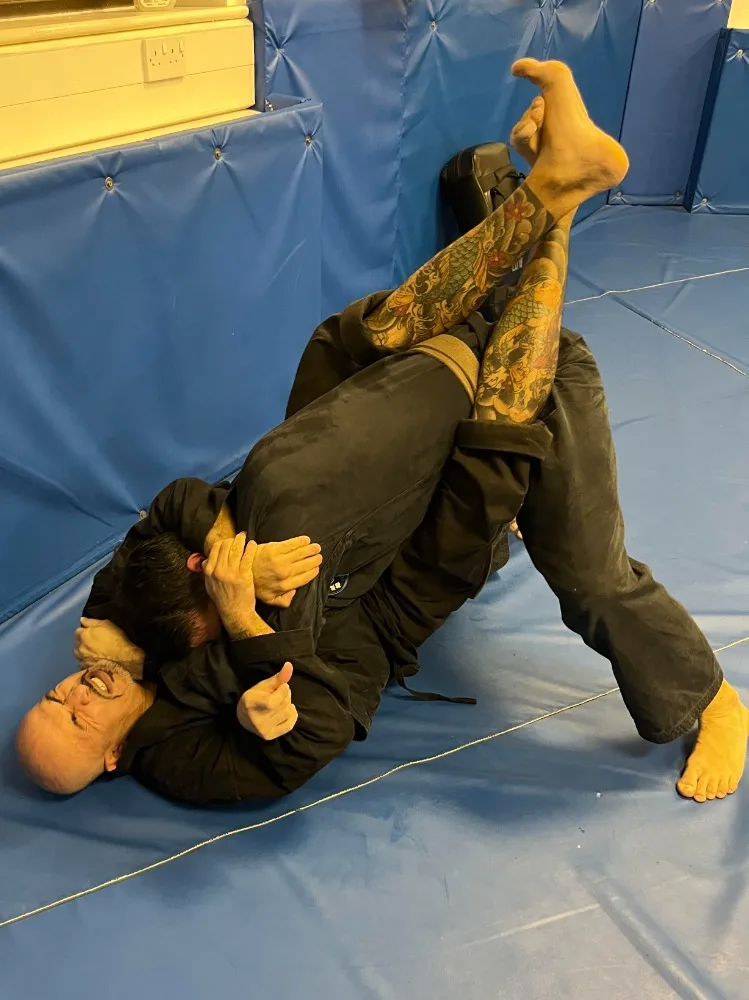
BJJ revolutionised martial arts understanding through the early UFC, demonstrating that ground fighting skills allow even smaller practitioners to control and submit larger opponents. The art focuses on positional dominance, joint locks, and chokes, techniques that can neutralise threats without causing permanent injury.
For self-defence, BJJ provides invaluable skills for situations where you've been taken to the ground or tackled. The ability to control an attacker so they cannot hit you, or escape a mounted position, addresses scenarios that purely striking-based arts ignore completely.
However, BJJ's sporting evolution has created a significant caveat. Competition-focused academies often teach techniques optimised for points or submission victories against other BJJ practitioners, strategies that may be counterproductive in street situations where weapons, improvised weapons and multiple attackers change the calculus entirely.
Strengths: Exceptional ground control techniques work regardless of size differential, allows controlled responses proportionate to threats, builds tremendous physical resilience. Grades are rightly difficult to achieve.
Limitations: Deliberately going to the ground in street situations carries serious risks, minimal standing defence training, doesn't address weapons or multiple attackers. Some academies do not cover how to get to the floor and focus on what happens only after you get there. Every round is a matter of life and death attitude causes regular injuries.
Best for: Anyone wanting comprehensive ground defence skills, particularly those concerned about being overpowered by larger attackers. Great for female self defence.
Boxing: Simple, Effective Striking
Sometimes the simplest solutions prove most effective. Boxing teaches only a handful of techniques; jabs, crosses, hooks, uppercuts, body shots, distancing and head movement but develops them to extraordinary levels of competence.
This simplicity becomes an advantage under stress. A well-trained boxer doesn't need to select from dozens of possible responses; they've drilled a small set of highly effective combinations thousands of times until they're completely automatic. Combined with footwork and defensive head movement, boxing provides formidable standing defence capability.
Boxing training also develops attributes that transfer across all fighting contexts: timing, distance management, the ability to remain calm while being attacked, and genuine punching power generated through proper mechanics rather than muscling through strikes.
Strengths: Techniques become deeply ingrained through repetition, develops real punching power, excellent fitness component, teaches great movement, relatively quick to develop functional skills. Practical against multiple opponents.
Limitations: Punches to the head carry injury risk to hands without gloves, no kicks or grappling, no ground defence, and don't address weapons or clinch situations.
Best for: Those wanting highly effective striking skills developed through intensive drilling and sparring.
Muay Thai: The Art of Eight Limbs
Thailand's national martial art utilises punches, kicks, elbows, and knees, a comprehensive striking arsenal that provides answers at every distance. The clinch work, often neglected in other striking arts, proves particularly valuable when confrontations become close-range grappling exchanges.
Shin kicks and knees and elbows to the body can compromise an attacker's mobility and enthusiasm without the legal complications of head strikes. The clinch offers vertical control.
The conditioning component of Muay Thai training, including hardening of the body and the mind and developing tolerance for impact, creates practitioners who can both deliver and absorb significant force.
Strengths: Complete standing striking system, excellent clinch control, low kicks provide non-lethal stopping power, develops physical toughness, techniques are effective.
Limitations: No ground defence, doesn't address weapons, some techniques (spinning elbows, head kicks) are impractical for street situations. Egos, sparring intensity and injury rate.
Best for: Those seeking comprehensive striking capabilities across all ranges with particular strength in clinch fighting.
Karate: Traditional Techniques with Practical Applications
Karate receives criticism in self-defence discussions, largely because most exposure comes from sport variants with point based sparring, and aesthetics concerned team kata type training or poor-quality rigid instruction. Traditional Okinawan karate, the original art before sporting adaptations were developed, was specifically a civilian self-defence system.
Beyond striking, traditional karate includes throws, joint locks, and grappling techniques often overlooked in competition-focused schools. The emphasis on generating power from stable stances suits realistic situations. Defence against grabs, chokes, and basic weapon threats forms part of traditional training.
The discipline's emphasis on mental development, respect, and controlled aggression produces practitioners who understand when force is appropriate and can modulate their responses accordingly, crucial for legal defensibility.
Strengths: Addresses both striking and basic grappling, heavy handed, emphasis on mental discipline and appropriate responses, lifetime progression pathway. If you find the right dojo, and the instructor, it will be a life changing journey.
Limitations: Quality varies enormously between schools, sport karate techniques often ineffective for self-defence, limited ground defence.
Best for: Those seeking martial arts training that develops both physical skills and character.
Why Single-Discipline Training Has Limitations
Every martial art developed within specific contexts and constraints.
Boxing regulations prohibit kicks, grappling, and ground fighting.
Brazilian Jiu-Jitsu does not cover enough, taking your opponent down.
Judo does not cover how to close the distance safely against strikes.
Taekwondo does not cover vertical grappling and close quarters and ground.
No single discipline addresses every realistic threat scenario:
| Scenario | Striking Arts | Grappling Arts | Self Defence |
|---|---|---|---|
| Standing altercation | Excellent | Limited | Varies |
| Ground defence | Poor | Excellent | Varies |
| Multiple attackers | Moderate | Poor | Good |
| Knife threat | Poor | Very poor | Good |
| Close-range clinch | Moderate | Good | Good |
| Legal proportionality | Moderate | Excellent | Good |
| Awareness training | Rarely taught | Rarely taught | Excellent |
This isn't a criticism of any particular art, each developed to address specific challenges excellently. The limitation lies in believing any single approach provides complete preparation.
The Case for Cross-Training Multiple Styles
Mixed martial arts competition demonstrated what many practitioners already understood: complete fighters require skills from multiple disciplines. The same principle applies to self-defence, where threats don't announce what form they'll take.
Cross-training creates what coaches call "transitions", the ability to move between ranges and fighting contexts fluidly. When standing defence fails and you're taken to the ground, can you respond? When ground fighting is interrupted by the attacker's friend approaching, can you escape and address the new threat?
The challenge lies in achieving sufficient depth across multiple disciplines. Simply attending one boxing class, one BJJ class, and one karate class weekly produces a confused practitioner rather than a versatile one.
Effective cross-training requires structured integration—understanding how techniques from different disciplines complement each other and when to deploy specific skills.
Self-Defence Beyond Physical Techniques
The most practitioners we've trained share something beyond physical skill: heightened awareness and the social intelligence to avoid or de-escalate threats before they become physical.
Situational awareness means noticing potential threats early, the group becoming rowdy at the pub, the individual who seems to be following you, the car that's circled the block twice. Early recognition creates options: crossing the street, entering a shop, calling for help.
De-escalation involves communication skills that defuse aggression without triggering escalation. Body language, tone, creating face-saving exits for aggressive individuals, these skills prevent confrontations.
Legal understanding matters enormously in the UK context. Self-defence must be reasonable and proportionate. Understanding these boundaries affects technique selection and response levels.
Any comprehensive self-defence programme addresses these elements alongside physical techniques. Training that focuses exclusively on fighting overlooks the majority of situations where awareness and communication determine outcomes.
How Shuhari Combines Multiple Disciplines for Complete Protection
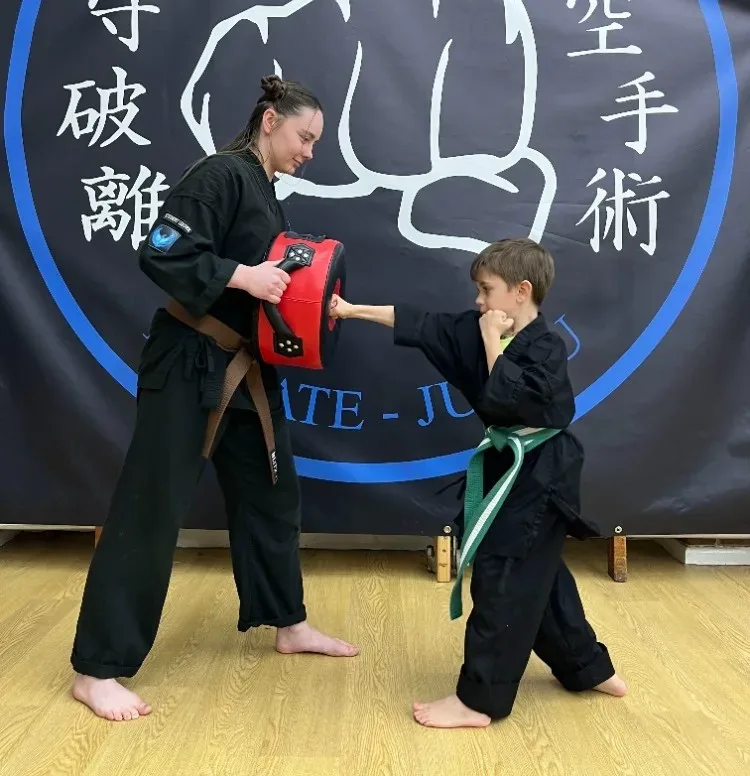
Our approach at Shuhari is to integrate techniques from distinct styles: Karate, Boxing, Wrestling, Krav Maga, Kung Fu, Judo, Brazilian Jiu-Jitsu, Kickboxing, and Muay Thai.
This isn't random mixing, each discipline contributes specific capabilities:
Boxing techniques develop punching mechanics and defensive head movement. Karate and Kickboxing techniques provide our kicking base. Muay Thai adds clinch control and devastating close-range options like elbows and knees. Wrestling and Judo create takedown defence and the ability to control where fights happen. BJJ ensures ground competence when other options fail. Krav Maga concepts contribute scenario-based training and weapon defence.
Beyond techniques, our training develops the awareness, confidence, and mental resilience that characterise truly prepared individuals. The Shuhari philosophy, "Strong Body, Sharp Mind, Immovable Spirit" recognises that physical capability represents just one component of genuine security.
Students progress through our syllabus rather than parallel tracks, learning how skills connect across disciplines. The result: versatile practitioners prepared for realistic scenarios, not specialised competitors vulnerable outside their trained context.
Finding Your Path Forward
The question "which martial art is best for self-defence?" ultimately has a personalised answer depending on your specific circumstances, concerns, and commitment level.
If your primary concern is ground defence against larger attackers, BJJ deserves serious consideration. If you want rapid, practical skills and awareness without traditional martial arts culture, Krav Maga may suit best. If you're seeking lifetime discipline, meditation, character development alongside physical skills, traditional martial arts offer profound benefits.
For comprehensive preparation that addresses the full spectrum of realistic threats, cross-training approaches that integrate multiple disciplines provide the most thorough protection.
What matters most is the beginning. The untrained individual facing a threat has dramatically fewer options than someone with even basic martial arts experience. Whatever direction you choose, starting creates momentum that transforms uncertainty into capability.
Ready to Experience Complete Self-Defence Training?
Discover how our multi-discipline approach prepares you for any situation. Book your free trial class at any of our six Berkshire locations, Slough, Maidenhead, Bracknell, Cippenham, Burnham, or Langley and experience training that develops your complete defensive capability.
Or call us directly: 07739 464005
Classes available for children (7+), teenagers, and adults. No experience necessary.
Frequently Asked Questions
Which martial art is most effective in a real fight?
No single martial art addresses all realistic threat scenarios. Striking arts like boxing and Muay Thai excel at standing confrontations, while BJJ and Sambo dominate ground situations. Comprehensive self-defence requires either cross-training multiple disciplines or studying integrated approaches combining techniques from various arts.
Can I learn self-defence without martial arts training?
Basic awareness and de-escalation skills can be learned independently, and these prevent more confrontations than physical techniques. However, developing reliable physical defensive capability requires structured training with qualified instructors and regular practice against resisting partners.
How long does it take to learn effective self-defence?
Functional basic skills can develop within a year or two of consistent training. However, genuine competence, the ability to respond effectively under stress against varied threats typically requires 5-10 years of practice. Self-defence capability continues developing throughout your training journey.
Is martial arts training safe for beginners?
Quality martial arts instruction prioritises safety through proper progression, appropriate protective equipment, and controlled training environments. Beginners at reputable schools like Shuhari train at intensity levels matching their experience, with instructors monitoring all activities to prevent injuries.
What's the difference between MMA and self-defence training?
MMA prepares athletes for regulated competition against single opponents with rules, referees, and prohibited techniques. Self-defence training addresses realistic scenarios including multiple attackers, weapons, environmental factors, and legal considerations absent from sporting contexts.